
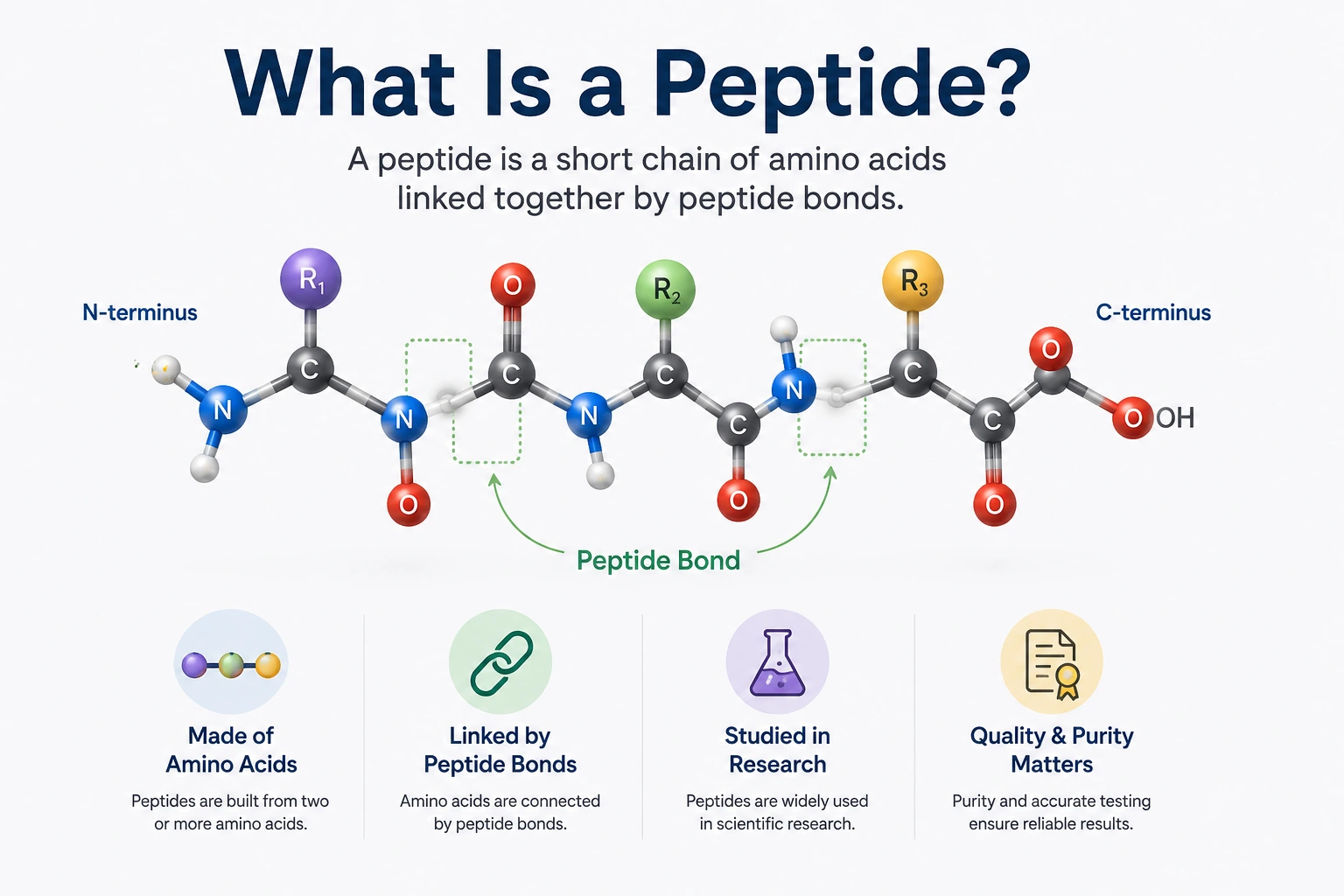
What is a peptide? A peptide is a molecule made from two or more amino acids connected through chemical links known as peptide bonds. These amino acid chains are fundamental subjects in biochemistry, molecular biology, analytical chemistry, and laboratory research.
Although peptides and proteins are closely related, they are not always considered the same type of molecule. Their chain length, molecular structure, folding behavior, and research characteristics can differ considerably.
Understanding what peptides are, how they are formed, and how researchers analyze them provides a useful foundation for studying molecular interactions, amino acid sequences, biochemical pathways, and laboratory synthesis.
This guide explains peptides from a research and chemistry perspective, including their structure, classification, synthesis, analytical characterization, and relationship with proteins.
Peptides are primarily composed of amino acids, which are organic molecules containing functional groups involved in forming larger molecular structures.
When amino acids connect in a defined sequence, they produce an amino acid chain. The order of amino acids within this chain is known as the amino acid sequence.
Each sequence can create different chemical and structural characteristics.
A peptide may contain only a few amino acids or a considerably longer chain. Researchers commonly study peptide sequences to understand how molecular composition influences properties such as:
This relationship between sequence and molecular behavior is one reason peptides remain important research materials across several scientific disciplines.
A peptide bond is the chemical connection that joins one amino acid to another.
It typically forms between the carboxyl group of one amino acid and the amino group of another. During this process, the molecules become connected through an amide-type linkage.
As additional amino acids are connected, the chain becomes progressively longer.
For example:
Two connected amino acids form a dipeptide.
Three connected amino acids form a tripeptide.
A relatively short chain containing several amino acids may be described as an oligopeptide.
Longer chains are often described as polypeptides.
The peptide bond is therefore one of the central structural features researchers examine when studying peptide chemistry.
Peptides can be formed through biological processes or produced through controlled laboratory synthesis.
From a chemical perspective, peptide formation involves connecting individual amino acids in a specific order.
The resulting sequence has two distinct ends:
N-terminus: The end containing the available amino group.
C-terminus: The end containing the available carboxyl group.
Scientists generally describe peptide sequences from the N-terminus toward the C-terminus.
The precise arrangement matters because two peptides containing the same amino acids can have different molecular characteristics when those amino acids appear in different sequences.
This makes peptide sequencing an important part of biochemical and analytical research.
One of the most common questions surrounding peptide science is the difference between peptides and proteins.
Both are built from amino acids connected through peptide bonds. The distinction is largely related to molecular size, structural complexity, and convention.
Peptides generally consist of shorter amino acid chains, while proteins are usually larger molecules capable of developing complex three-dimensional structures.
There is no universally fixed amino acid number that separates every peptide from every protein. Scientific terminology can vary depending on research context.
A simplified comparison looks like this:
Peptides generally have shorter amino acid sequences and may possess relatively compact molecular structures. They are commonly studied in areas such as peptide chemistry, molecular interactions, analytical characterization, and structure-activity research.
Proteins usually contain longer amino acid chains and can fold into highly organized three-dimensional structures. These structures may include multiple domains or interacting chains.
Because the boundary is not always absolute, researchers often consider molecular structure and scientific context alongside chain length when describing a compound as a peptide or protein.
Peptides can be classified in several ways, including according to chain length, chemical structure, sequence, and research context.
A dipeptide contains two amino acids connected by a single peptide bond.
Because of their relatively simple structure, dipeptides can be useful model molecules for investigating fundamental aspects of peptide chemistry.
A tripeptide consists of three amino acids connected through peptide bonds.
These molecules remain structurally small but provide greater sequence complexity than dipeptides.
Oligopeptides are relatively short chains containing several amino acid residues.
The precise definition may vary between scientific sources, but the term generally refers to molecules larger than simple dipeptides and tripeptides yet shorter than larger polypeptide chains.
A polypeptide contains a longer sequence of amino acids connected through peptide bonds.
Some polypeptides may develop more complex structural characteristics depending on their length, sequence, and surrounding chemical environment.
A peptide is not defined only by how many amino acids it contains.
The sequence of amino acids is equally important.
Imagine two chains containing the same collection of amino acids. If those amino acids are arranged in a different order, the resulting molecules may behave differently.
Sequence can influence:
For this reason, researchers carefully document the precise amino acid sequence when synthesizing, identifying, or characterizing peptide materials.
Sequence confirmation may also form part of laboratory analytical workflows.
Modern laboratories can produce peptides through several chemical and biochemical methods.
One widely recognized approach is solid-phase peptide synthesis, commonly abbreviated as SPPS.
In solid-phase peptide synthesis, amino acids are added sequentially while the developing peptide chain remains attached to a solid support.
The process typically involves repeated cycles of chemical reactions that allow researchers to build the desired amino acid sequence in a controlled manner.
After synthesis, additional laboratory procedures may be used to separate the target material from reaction by-products and other impurities.
Peptide synthesis can become more challenging as chain length and molecular complexity increase, which makes purification and analytical verification important parts of research workflows.
Producing the intended amino acid sequence does not automatically mean that a synthesized sample contains only the target molecule.
Chemical synthesis may produce incomplete sequences, side products, residual reagents, or structurally related impurities.
For this reason, purification is commonly performed after synthesis.
One technique frequently associated with peptide purification is high-performance liquid chromatography, or HPLC.
Chromatographic techniques separate molecular components according to differences in their interactions with a stationary and mobile phase.
Researchers can then examine collected fractions and determine which contain the desired research material.
Purification procedures depend on the characteristics of the compound and the objectives of the laboratory.
Analytical characterization is an important part of peptide research because appearance alone cannot establish molecular identity or purity.
Laboratories may use multiple analytical techniques to evaluate research materials.
HPLC is commonly used to examine sample composition and chromatographic purity.
During analysis, different components within a sample may produce separate chromatographic signals or peaks.
The resulting chromatogram provides researchers with useful information about sample composition under the specific test conditions used.
Mass spectrometry is another important analytical technique in peptide research.
It can provide information about molecular mass and support molecular identity assessment.
When used alongside other analytical methods, mass spectrometry can help researchers determine whether the measured molecular characteristics correspond with the expected peptide structure.
Depending on the research material and laboratory requirements, scientists may also use techniques such as:
No single analytical technique necessarily provides every piece of information about a peptide sample. Researchers often interpret multiple forms of data together.
Peptide purity generally refers to the proportion of the target peptide relative to detectable related components under a defined analytical method.
For example, chromatography may be used to estimate relative sample purity.
However, a purity percentage should always be interpreted in the context of the testing method.
Purity is not automatically the same thing as:
This distinction is important when reviewing analytical documentation.
A high chromatographic purity result answers a specific analytical question. It does not independently establish every characteristic of a research sample.
A Certificate of Analysis, commonly called a COA, is a document that summarizes selected analytical information associated with a particular material or lot.
Depending on the supplier and testing laboratory, a COA may include information such as:
Researchers should pay attention to whether the documentation corresponds to the specific batch being evaluated.
Lot-specific documentation can improve traceability and make it easier to connect analytical results with the material received by a laboratory.
HPLC and mass spectrometry answer different analytical questions.
HPLC can help researchers evaluate how many detectable components appear under particular chromatographic conditions and estimate the relative proportion associated with the target peak.
Mass spectrometry can provide information related to molecular mass.
Using the two approaches together can therefore provide a broader analytical picture than relying on either method alone.
For example, chromatographic data may support purity assessment while mass data may support molecular identity.
This complementary approach is common across analytical chemistry.
Peptides are widely studied because amino acid chains participate in numerous molecular processes.
In research environments, scientists may investigate peptide interactions with:
These investigations can help researchers better understand biochemical mechanisms and structure-function relationships.
The specific purpose of a peptide experiment depends on the research model, molecular target, laboratory methodology, and experimental question.
Structure-activity relationship, often abbreviated as SAR, examines how changes in molecular structure influence measured activity or interaction within an experimental system.
For peptide research, scientists may modify:
Researchers can then compare experimental results between related molecular structures.
This allows scientists to explore which structural characteristics appear to influence a particular experimental observation.
SAR research is used broadly across chemistry and molecular science and is not limited to peptides.
Two materials labeled with the same peptide name may not necessarily have identical analytical characteristics.
Differences can potentially occur in:
This is why laboratory documentation and analytical characterization matter.
Researchers typically benefit from having enough information to understand exactly which material is being used in an experiment.
Traceable batch documentation can also help laboratories reproduce methods and compare findings across different experiments.
Storage conditions depend on the specific molecule, formulation, physical state, packaging, and manufacturer documentation.
Variables such as temperature, light exposure, moisture, oxygen, and repeated environmental changes can influence material stability.
Researchers should therefore rely on documented storage and handling specifications associated with the individual compound rather than assuming that every peptide requires identical conditions.
Good laboratory practice may also include maintaining clear records related to:
This helps improve research traceability.
Understanding a few basic terms can make peptide-related scientific literature easier to interpret.
An organic molecule that can function as a building block of peptides and proteins.
An amino acid unit after it has become incorporated into a peptide chain.
The chemical bond connecting amino acid residues within a peptide.
The amino end of a peptide chain.
The carboxyl end of a peptide chain.
The specific order in which amino acid residues occur within the molecule.
A measurement describing the molecular mass of a compound.
A chromatographic analytical method used for separation and sample characterization.
An analytical technique that measures ions according to their mass-to-charge ratio and can support molecular characterization.
A Certificate of Analysis containing selected analytical information related to a material or batch.
Peptides occupy an interesting position between individual amino acids and larger proteins.
Their structures can be small enough for controlled chemical modification while still being complex enough to support detailed molecular investigations.
As a result, peptides are studied in fields including:
Advances in synthesis, chromatography, mass spectrometry, and computational analysis have also expanded the ways scientists can produce and characterize peptide sequences.
A peptide is a molecule consisting of amino acids connected together through peptide bonds. The specific order of those amino acids creates the peptide’s sequence.
Peptides are made from amino acid residues joined together through chemical bonds known as peptide bonds.
Not exactly. Both peptides and proteins consist of amino acids, but peptides are generally shorter molecular chains, while proteins tend to be larger and may form more complex three-dimensional structures.
There is no single universal number that defines every peptide. Dipeptides contain two amino acids, tripeptides contain three, while oligopeptides and polypeptides contain progressively longer sequences.
A peptide bond forms when amino acids become chemically connected through an amide linkage involving their amino and carboxyl functional groups.
An amino acid sequence is the specific order of amino acid residues within a peptide or protein chain.
Solid-phase peptide synthesis (SPPS) is a laboratory method in which a peptide chain is assembled step by step while attached to a solid support.
Chromatographic techniques such as HPLC are commonly used to examine the relative composition of peptide samples under defined analytical conditions.
Mass spectrometry can provide molecular mass information that supports the analytical characterization and identification of peptide materials.
A COA may include batch information, analytical methods, reported purity, chromatographic data, molecular mass results, testing dates, and other lot-specific laboratory information.
Understanding what a peptide is begins with understanding amino acids and the chemical bonds that connect them.
Peptides are amino acid chains whose properties depend on factors such as sequence, chain length, molecular structure, and chemical environment. They can range from simple dipeptides to considerably larger polypeptide structures.
In laboratory research, studying peptides involves much more than identifying a sequence. Scientists may also examine peptide synthesis, molecular mass, purity, structural characteristics, chromatography results, and other analytical data.
Reliable characterization and traceable documentation help researchers understand the materials being evaluated and support more controlled experimental work.
As analytical technologies continue to advance, peptide research remains an important area within chemistry, biochemistry, molecular biology, and related scientific disciplines.
Research Use Notice: Information presented in this article is provided for educational and laboratory research purposes only. Research compounds discussed in this context are not intended for human or veterinary use and are not intended to diagnose, treat, cure, or prevent any disease.